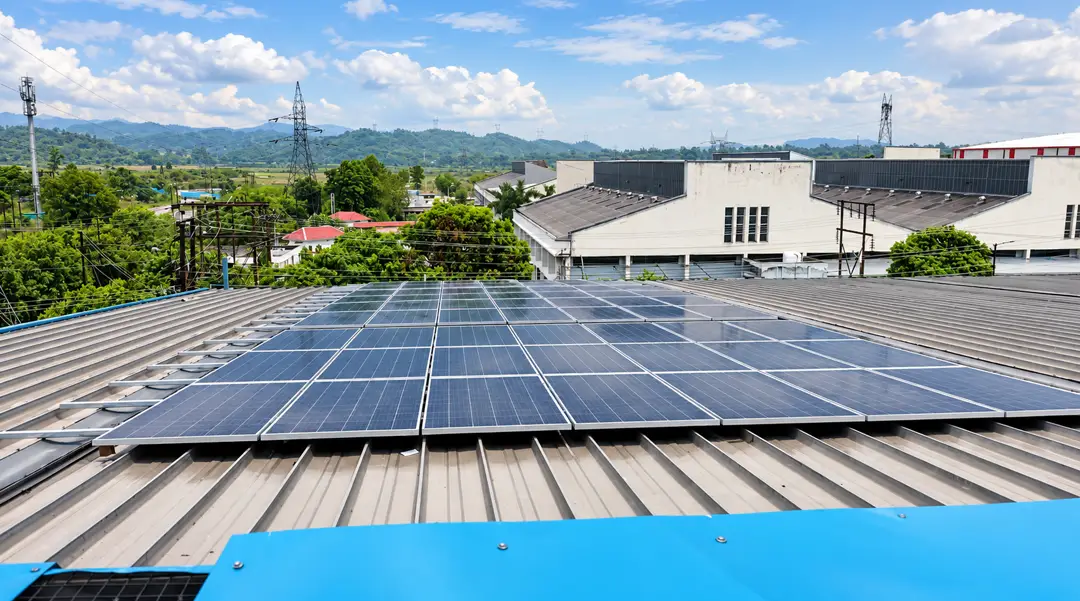
Somaya Solar Solutions Limited delivers turnkey solar projects in Ghaziabad, Uttar Pradesh: one contract that runs from the first survey to a commissioned plant with its approvals in place.
What turnkey means in practice
In a turnkey contract you hand over the site and the requirement and take back a working plant. One contract covers every step in between.
- One price and one schedule covering design, supply, installation and commissioning
- Approvals and metering paperwork handled by the contractor
- Defined tests before handover, with drawings, warranties and manuals
- A named point of contact through the project
- Operation and maintenance after handover, where contracted
More detail: Turnkey Solar EPC across India.
Steps in a turnkey project in Ghaziabad
- Survey of the site and a study of twelve months of bills
- Design, drawings and a fixed-price proposal
- Application to the electricity supplier (PVVNL) for connection and metering
- Equipment supply and installation
- Testing, inspection and commissioning
- Handover with drawings, warranties and monitoring access
Approvals a turnkey contract covers in Ghaziabad
In Uttar Pradesh, commercial and industrial consumers do not get net metering. Under the regulator's rooftop solar regulations of 2019, as amended, they can use net billing (also called net feed-in) or gross metering. Net metering is kept for domestic and metered agricultural consumers and, since November 2023, for public and educational institutions.
The size limits, charges and other conditions for Uttar Pradesh are on the page Turnkey Solar EPC in Uttar Pradesh.
In Ghaziabad the application for connection and metering goes to PVVNL.
What to expect from the plant in Ghaziabad
A solar plant in Ghaziabad is modelled to produce about 1,420 units (kWh) a year for each kW installed, for a rooftop array at a 10° tilt. The last column values that energy at the Large and Heavy Power (HV-2, supply up to 11 kV, urban schedule) energy charge of ₹7.10 per kVAh (UPERC tariff order of 2 July 2026 for 2026-27). It leaves out fixed and demand charges, surcharges, duty and the effect of the metering rules, so it is a rough guide, not a savings promise. This charge is billed per kVAh. The table counts one kWh as one kVAh, which is close when the power factor is near 1.
| Plant size | Modelled output a year | Shadow-free roof needed (typical) | Value at ₹7.10 per kVAh |
|---|---|---|---|
| 100 kW | 1.4 lakh units | 1,000 sq m | ₹10.1 lakh |
| 500 kW | 7.1 lakh units | 5,000 sq m | ₹50.4 lakh |
| 1 MW | 14.2 lakh units | 10,000 sq m | ₹1.01 crore |
Output figures are modelled with the European Commission's PVGIS tool (ERA5 weather data, 2005 to 2023) with system losses set at 20%, which is on the cautious side. Real output depends on shading, dust, equipment and layout. A site study gives the figure to plan on.
Reference projects near Ghaziabad
These are the Somaya Solar projects closest to Ghaziabad, with straight-line distances. They are shown as references and are not in Ghaziabad unless the line says so.
- KUSUM-A, Bhavnath Singh: 2.4 MW ground-mounted plant under PM-KUSUM Component A, Amroha, Uttar Pradesh, about 100 km from Ghaziabad. In progress. Site access was difficult and was handled with local support.
- Akums Limited: 2.3 MW rooftop plant, SIDCUL, Haridwar, Uttarakhand, about 160 km from Ghaziabad. In progress. The roof is more than 70 feet above the ground, so material is lifted by several cranes.
- Luminous: 1 MW rooftop plant, Haridwar, Uttarakhand, about 160 km from Ghaziabad. Included net-metering coordination with the local electricity distribution company.
Questions about solar projects in Ghaziabad
Which electricity company handles solar connections in Ghaziabad?
Pashchimanchal Vidyut Vitran Nigam Limited (PVVNL), the state distribution company with its head office in Meerut, supplies electricity in Ghaziabad district. Ghaziabad is one of the 14 districts PVVNL lists as its area.
Is net metering available for factories and commercial buildings in Ghaziabad?
Net billing or gross metering; no net metering for industry or commerce. The rule is the same across Uttar Pradesh.
How much electricity does a solar plant generate in Ghaziabad?
About 1,420 units (kWh) a year for each kW installed, by the PVGIS model with cautious loss settings. A 1 MW plant works out to about 14.2 lakh units a year. A site study gives the figure to plan on.
Where is Somaya Solar based, and how far is that from Ghaziabad?
Somaya Solar Solutions Limited works from C-159, Bulandshahr Road Industrial Area, Ghaziabad, Uttar Pradesh, about 5 km from Ghaziabad in a straight line. The closest published project is KUSUM-A, Bhavnath Singh (2.4 MW ground-mounted plant under PM-KUSUM Component A) in Amroha, about 100 km away.
What does Somaya Solar need to prepare a proposal?
Twelve months of electricity bills, the sanctioned load or contract demand, the roof or land details with photographs, and the plant size you have in mind if you have one.
Discuss a solar project in Ghaziabad
Send your electricity bills, sanctioned load and roof or land details, and we will reply with a first assessment.
Email: info@somayasolar.com
Phone: +91-8700035846
Sources
Local rules and figures on this page were last checked on 17 November 2026. Rules and tariffs change; confirm the current position before you commit to a project.
- GeoNames (place coordinates, CC BY 4.0)
- PVGIS, European Commission Joint Research Centre (solar output model)
- PVVNL website: Introduction (districts served)
- UPERC (Rooftop Solar PV Grid Interactive Systems Gross/Net Metering) Regulations, 2019, with amendments of 1 June 2022, 17 November 2023 and 3 June 2025; UPERC tariff order of 2 July 2026, paragraph 3.13.5
- UPERC tariff order for 2026-27 for the state distribution companies, dated 2 July 2026