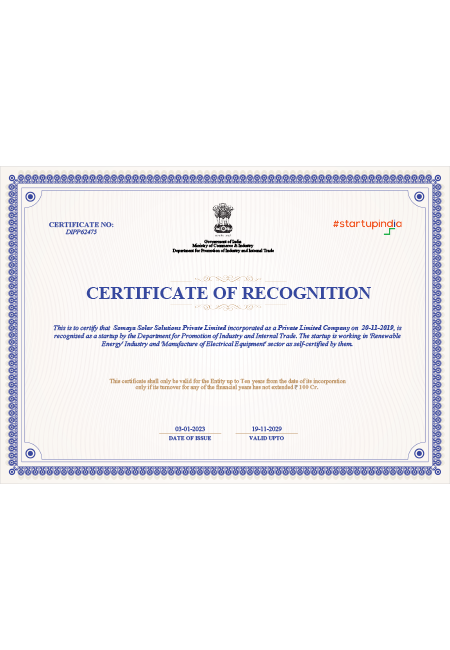
Somaya Solar Solutions Limited installs rooftop solar plants for factories, warehouses, institutions and commercial buildings in Hapur, Uttar Pradesh. Most of our published work is megawatt-scale rooftop plants on working industrial sites.
Hapur and the National Capital Region
Hapur district is one of the eight Uttar Pradesh districts in the National Capital Region, by the list of the NCR Planning Board.
The Graded Response Action Plan for air quality covers the whole National Capital Region. From Stage I, diesel generator sets are not to be used as a regular source of power, and from Stage II their running is regulated across industrial, commercial and residential users. Solar does not replace backup power on its own, but it cuts the daytime energy a unit has to draw from the grid.
The Government of India's One District One Product (ODOP) list names Home Decorative Goods as the product of Hapur district.
Metering rules for business rooftops in Hapur
In Uttar Pradesh, commercial and industrial consumers do not get net metering. Under the regulator's rooftop solar regulations of 2019, as amended, they can use net billing (also called net feed-in) or gross metering. Net metering is kept for domestic and metered agricultural consumers and, since November 2023, for public and educational institutions.
The size limits, charges and other conditions for Uttar Pradesh are on the page Commercial & Industrial Solar in Uttar Pradesh.
In Hapur the application for connection and metering goes to PVVNL.
Output and bill value for a rooftop plant in Hapur
A solar plant in Hapur is modelled to produce about 1,410 units (kWh) a year for each kW installed, for a rooftop array at a 10° tilt. The last column values that energy at the Large and Heavy Power (HV-2, supply up to 11 kV, urban schedule) energy charge of ₹7.10 per kVAh (UPERC tariff order of 2 July 2026 for 2026-27). It leaves out fixed and demand charges, surcharges, duty and the effect of the metering rules, so it is a rough guide, not a savings promise. This charge is billed per kVAh. The table counts one kWh as one kVAh, which is close when the power factor is near 1.
| Plant size | Modelled output a year | Shadow-free roof needed (typical) | Value at ₹7.10 per kVAh |
|---|---|---|---|
| 100 kW | 1.4 lakh units | 1,000 sq m | ₹10.0 lakh |
| 250 kW | 3.5 lakh units | 2,500 sq m | ₹25.0 lakh |
| 500 kW | 7.0 lakh units | 5,000 sq m | ₹50.1 lakh |
| 1 MW | 14.1 lakh units | 10,000 sq m | ₹1.00 crore |
Output figures are modelled with the European Commission's PVGIS tool (ERA5 weather data, 2005 to 2023) with system losses set at 20%, which is on the cautious side. Real output depends on shading, dust, equipment and layout. A site study gives the figure to plan on.
How a factory or commercial rooftop project runs
Rooftop plants on working buildings are planned around the roof, the load and the production schedule.
- Roof check: sheet or concrete, load capacity, shading and safe access
- Sizing against daytime load and sanctioned demand, within the metering rules above
- Mounting design to suit the roof, including corrosion protection where the air is harsh
- Installation in stages so production carries on
- Testing, metering and connection with the electricity supplier
- Monitoring and maintenance after handover, where contracted
More detail: Commercial & Industrial Solar across India.
Rooftop projects by Somaya Solar near Hapur
These are the Somaya Solar projects closest to Hapur, with straight-line distances. They are shown as references and are not in Hapur unless the line says so.
- Naini Papers Limited: 3 MW rooftop plant, Kashipur, Uttarakhand, about 130 km from Hapur. Completed in two months, with five years of operation and maintenance.
- Akums Limited: 2.3 MW rooftop plant, SIDCUL, Haridwar, Uttarakhand, about 140 km from Hapur. In progress. The roof is more than 70 feet above the ground, so material is lifted by several cranes.
- Luminous: 1 MW rooftop plant, Haridwar, Uttarakhand, about 140 km from Hapur. Included net-metering coordination with the local electricity distribution company.
Questions about solar projects in Hapur
Which electricity company handles solar connections in Hapur?
Pashchimanchal Vidyut Vitran Nigam Limited (PVVNL), the state distribution company with its head office in Meerut, supplies electricity in Hapur district. Hapur is one of the 14 districts PVVNL lists as its area.
Is net metering available for factories and commercial buildings in Hapur?
Net billing or gross metering; no net metering for industry or commerce. The rule is the same across Uttar Pradesh.
How much electricity does a solar plant generate in Hapur?
About 1,410 units (kWh) a year for each kW installed, by the PVGIS model with cautious loss settings. A 1 MW plant works out to about 14.1 lakh units a year. A site study gives the figure to plan on.
Where is Somaya Solar based, and how far is that from Hapur?
Somaya Solar Solutions Limited works from C-159, Bulandshahr Road Industrial Area, Ghaziabad, Uttar Pradesh, about 30 km from Hapur in a straight line. The closest published project is Naini Papers Limited (3 MW rooftop plant) in Kashipur, about 130 km away.
What does Somaya Solar need to prepare a proposal?
Twelve months of electricity bills, the sanctioned load or contract demand, the roof or land details with photographs, and the plant size you have in mind if you have one.
Discuss a solar project in Hapur
Send your electricity bills, sanctioned load and roof or land details, and we will reply with a first assessment.
Email: info@somayasolar.com
Phone: +91-8700035846
Sources
Local rules and figures on this page were last checked on 18 November 2026. Rules and tariffs change; confirm the current position before you commit to a project.
- Commission for Air Quality Management: Graded Response Action Plan (revised 21 November 2025)
- DPIIT, ODOP Product List V32 (19 August 2025); copy hosted by the Embassy of India, Algiers
- GeoNames (place coordinates, CC BY 4.0)
- National Capital Region Planning Board: NCR constituent areas (as on April 2018)
- PVGIS, European Commission Joint Research Centre (solar output model)
- PVVNL website: Introduction (districts served)
- UPERC (Rooftop Solar PV Grid Interactive Systems Gross/Net Metering) Regulations, 2019, with amendments of 1 June 2022, 17 November 2023 and 3 June 2025; UPERC tariff order of 2 July 2026, paragraph 3.13.5
- UPERC tariff order for 2026-27 for the state distribution companies, dated 2 July 2026