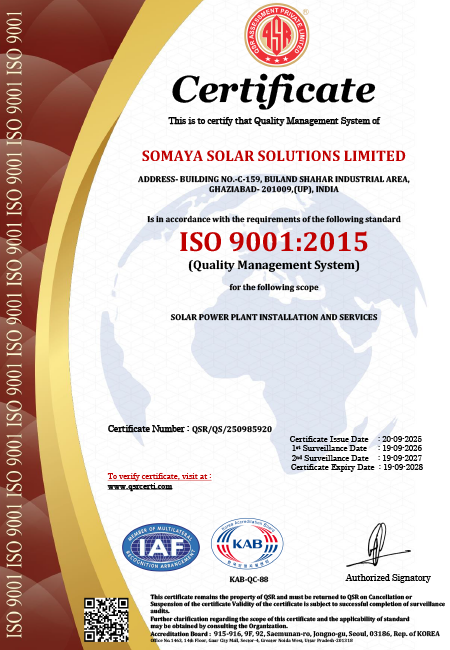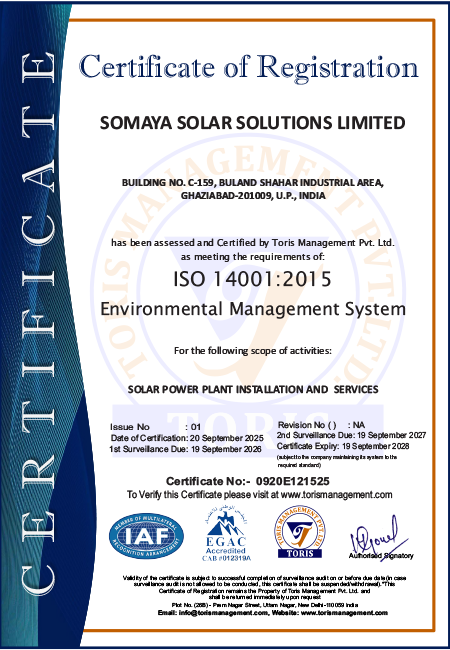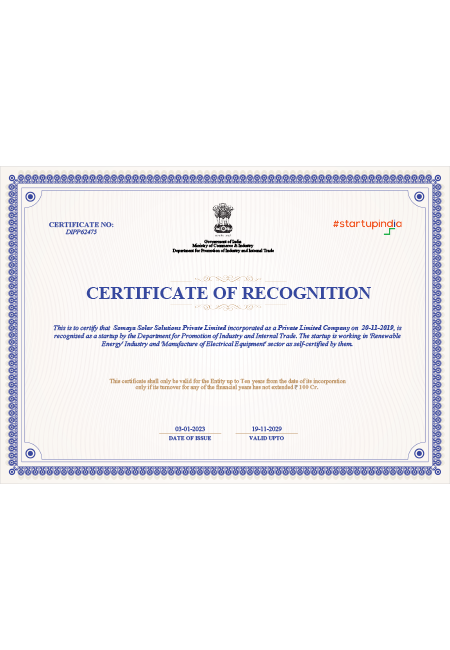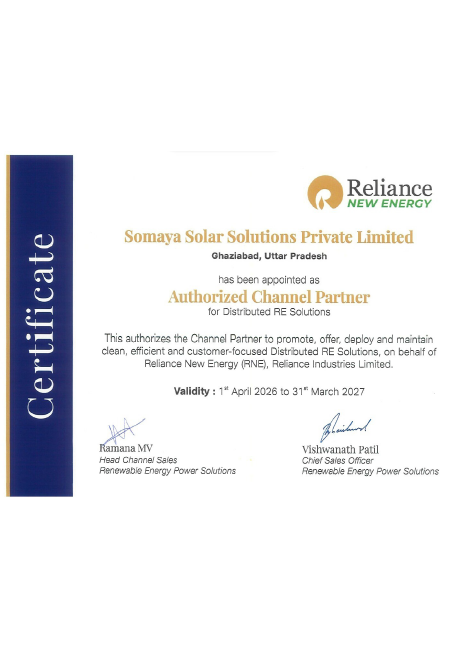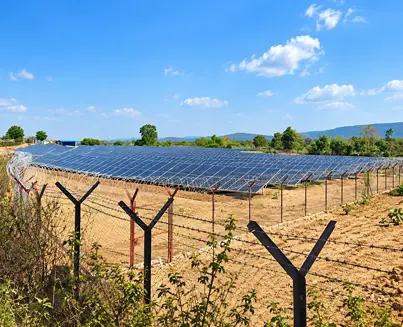
Somaya Solar Solutions Limited builds ground-mounted solar power plants in Chandigarh for businesses that want their own power and for landowners and developers who sell power to the grid.
Output and land for a ground-mounted plant in Chandigarh
A solar plant in Chandigarh is modelled to produce about 1,500 units (kWh) a year for each kW installed, for a ground-mounted array at the best fixed tilt (34°).
| Plant size | Modelled output a year | Land needed (typical) |
|---|---|---|
| 1 MW | 15.0 lakh units | 4 to 5 acres |
| 2 MW | 30.0 lakh units | 8 to 10 acres |
| 5 MW | 75.0 lakh units | 20 to 25 acres |
Output figures are modelled with the European Commission's PVGIS tool (ERA5 weather data, 2005 to 2023) with system losses set at 20%, which is on the cautious side. Real output depends on shading, dust, equipment and layout. A site study gives the figure to plan on.
State policy and open access in Chandigarh
Chandigarh has been selected by the Ministry of New and Renewable Energy to be developed as a Model Solar City. The Administration's Department of Science & Technology & Renewable Energy runs the programme through CREST, a registered society under the department. Chandigarh has no power plant of its own and little spare land, so the programme is built on rooftop solar plants.
- CREST is the executing agency of the Department of Science & Technology & Renewable Energy for rooftop solar plants. A Solar City cell has been set up in CREST.
- On 5 August 2026 the central government told the Lok Sabha that Chandigarh has reported saturation of its government buildings with rooftop solar systems.
- A rooftop plant, whether owned by the consumer or by a third party, comes under JERC's net metering regulations.
JERC brought green energy open access into its Connectivity and Open Access Regulations, 2017 through the Third Amendment of 2024, published in the Gazette of India on 19 September 2024. A consumer with a contract demand or sanctioned load of 100 kW or more can take renewable power through open access. The 100 kW can be one connection or several connections in the same electricity division.
- Captive consumers have no load limit.
- Banking is allowed within the month or billing cycle, up to 30% of the consumer's monthly consumption from the licensee. The banking charge is 8% of the banked energy, taken in units. Banked energy cannot be carried to the next month; unused energy lapses and the generator gets renewable energy certificates for it.
- For 2026-27 the tariff order sets a cross-subsidy surcharge of ₹0.61 per unit at HT and ₹0.82 per unit at EHT, and an additional surcharge of ₹1.32 per unit. Neither surcharge applies to captive use.
- The additional surcharge is not charged on green energy open access up to the contract demand if the consumer pays fixed charges to the licensee for it.
- The wheeling charge for 2026-27 is ₹0.78 per unit at HT and ₹0.12 per unit at EHT.
- Standby charges for a green energy open access consumer may not be more than 25% of the energy charge of the consumer's tariff category.
What a ground-mounted project involves
A ground-mounted plant needs more groundwork than a rooftop one before any module is fixed.
- Land check: title, slope, soil, drainage, access road and shading
- Distance to the substation or connection point and the line needed to reach it
- Layout, structure design and foundations for the soil
- Supply, installation, testing and commissioning
- Evacuation line, metering and connection approvals
- Fencing, cleaning water and maintenance planning
More detail: Ground-Mounted Solar Plant across India.
Ground-mounted projects by Somaya Solar near Chandigarh
These are the Somaya Solar projects closest to Chandigarh, with straight-line distances. They are shown as references and are not in Chandigarh unless the line says so.
- KUSUM-A, Bhavnath Singh: 2.4 MW ground-mounted plant under PM-KUSUM Component A, Amroha, Uttar Pradesh, about 260 km from Chandigarh. In progress. Site access was difficult and was handled with local support.
- KUSUM-C, Ram Sati Devi: 2.4 MW ground-mounted plant under PM-KUSUM Component C, Katni, Madhya Pradesh, about 850 km from Chandigarh. Completed, including the transmission line work coordinated with the local distribution company.
Questions about solar projects in Chandigarh
How much electricity does a solar plant generate in Chandigarh?
About 1,500 units (kWh) a year for each kW installed, by the PVGIS model with cautious loss settings. A 1 MW plant works out to about 15.0 lakh units a year. A site study gives the figure to plan on.
How much land does a solar plant need?
A fixed-tilt ground-mounted plant typically needs about 4 to 5 acres for each MW. The exact area depends on the module, the tilt and the shape of the plot.
Where is Somaya Solar based, and how far is that from Chandigarh?
Somaya Solar Solutions Limited works from C-159, Bulandshahr Road Industrial Area, Ghaziabad, Uttar Pradesh, about 240 km from Chandigarh in a straight line. The closest published project is KUSUM-A, Bhavnath Singh (2.4 MW ground-mounted plant under PM-KUSUM Component A) in Amroha, about 260 km away.
What does Somaya Solar need to prepare a proposal?
Twelve months of electricity bills, the sanctioned load or contract demand, the roof or land details with photographs, and the plant size you have in mind if you have one.
Discuss a solar project in Chandigarh
Send your electricity bills, sanctioned load and roof or land details, and we will reply with a first assessment.
Email: info@somayasolar.com
Phone: +91-8700035846
Sources
Local rules and figures on this page were last checked on 17 November 2026. Rules and tariffs change; confirm the current position before you commit to a project.
- Chandigarh Administration, Department of Science & Technology & Renewable Energy (web page, read 17 November 2026); Lok Sabha Unstarred Question 2920, answered 5 August 2026
- GeoNames (place coordinates, CC BY 4.0)
- JERC (Connectivity and Open Access in Intra-State Transmission and Distribution) (Third Amendment) Regulations, 2024 (No. JERC-21/2017, notified 13 August 2024, Gazette of India 19 September 2024), and JERC Tariff Order for Chandigarh of 30 October 2025
- PVGIS, European Commission Joint Research Centre (solar output model)