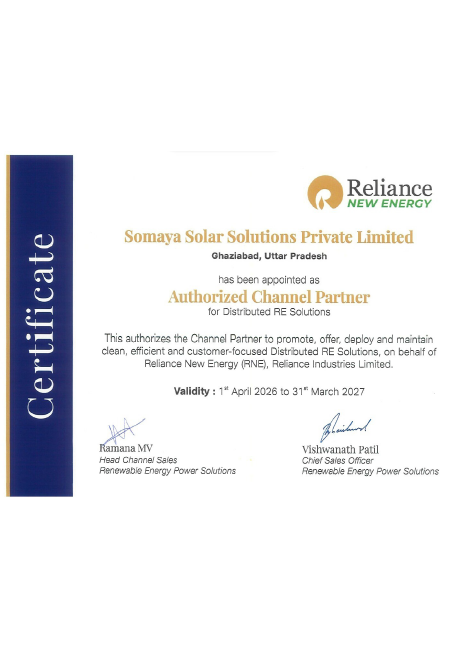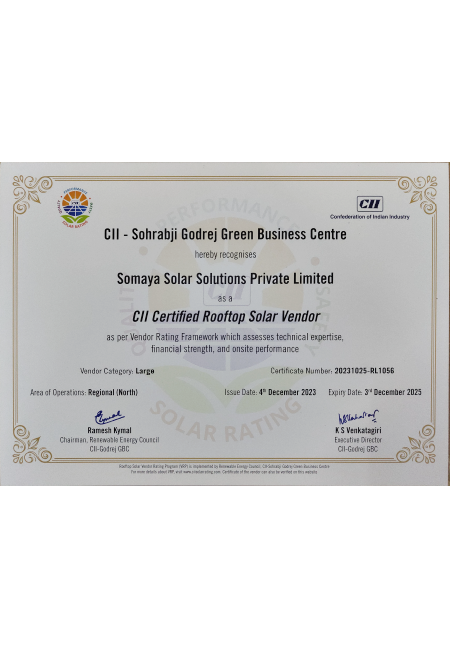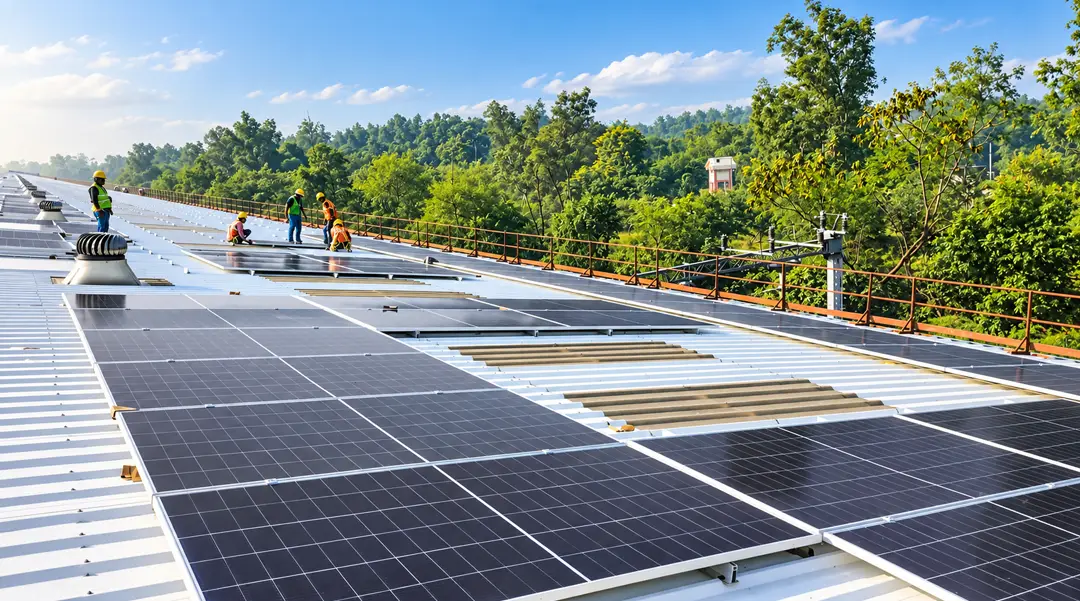
Somaya Solar Solutions Limited takes up megawatt-scale, grid-connected solar plants in Kerala as an EPC contractor: engineering, supply, construction and commissioning.
What Kerala's policy says about large solar plants
The Kerala Solar Energy Policy, 2013 is the solar policy that ANERT lists on its website. It says it stays in force until another policy supersedes or changes it. It is an old policy, and the 2025 regulations of the state regulator now set the metering, banking and captive rules. A draft Kerala Power Policy, 2025 has been published for discussion but is only a draft.
- Target: 500 MW of solar by 2017 and 2,500 MW by 2030.
- ANERT is the nodal agency for non-conventional energy in the state and for off-grid solar applications.
- The policy mandates a Solar Procurement Obligation for commercial consumers above 20 kVA connected load, LT industrial consumers above 50 kVA and all HT and EHT consumers. They may meet it by buying from solar plants in the state, buying RECs or buying from KSEB at the solar tariff.
- A consumer that wants an exemption from the obligation through captive solar must install separate meters for the captive generation.
In Kerala, open access is granted under KSERC's Connectivity and Intra-State Open Access Regulations, 2013 to consumers whose maximum power exceeds 100 kW. The 2025 renewable energy regulations say open access charges and surcharges follow those regulations and the tariff orders. The charges below are from the tariff schedule that runs from 5 December 2024 to 31 March 2027.
- Open access for renewable power from an independent producer or a captive plant is up to the plant capacity, the consumer's share in it, or the contract demand, whichever is lower.
- A captive consumer that wheels power to a different location in the state pays transmission charges, wheeling charges, losses and grid support charges. No cross-subsidy surcharge applies to a captive consumer.
- A consumer buying from an independent power producer through open access also pays the cross-subsidy surcharge.
- Transmission charge: ₹0.49 per unit for short-term open access and for open access by embedded consumers from RE sources in the state; ₹10,925 per MW per day for long-term and medium-term access. Wheeling charge: ₹0.64 per unit. SLDC charge: ₹104 per MW per day.
- Cross-subsidy surcharge: ₹1.58 per unit for HT-I(A) industry; ₹1.41, ₹1.34 and ₹1.36 per unit for EHT industrial at 66 kV, 110 kV and 220 kV.
- Banking: balance units carried to the next billing period lose 2% a month, and banking runs to the end of the financial year.
- Green tariff for consumers who choose renewable power from the licensee: ₹0.77 per unit over the normal tariff.
Output and land at megawatt scale in Kerala
Solar output changes across Kerala with latitude, haze and temperature. The table shows modelled yearly output for each kW installed, for a low-tilt rooftop array and for a ground-mounted array at the best fixed tilt. Across these places the figure runs from about 1,240 to 1,440 units per kW.
| Place | Rooftop, 10° tilt (kWh per kW a year) | Ground-mounted, best fixed tilt (kWh per kW a year) |
|---|---|---|
| Alappuzha | 1,280 | 1,290 |
| Kochi | 1,240 | 1,240 |
| Kollam | 1,400 | 1,400 |
| Kozhikode | 1,250 | 1,260 |
| Thiruvananthapuram | 1,440 | 1,440 |
Output figures are modelled with the European Commission's PVGIS tool (ERA5 weather data, 2005 to 2023) with system losses set at 20%, which is on the cautious side. Real output depends on shading, dust, equipment and layout. A site study gives the figure to plan on.
What utility-scale work involves
At megawatt scale the grid connection, land and delivery schedule decide the project as much as the equipment does.
- Land and grid-connection feasibility
- Detailed engineering for the plant and the evacuation system
- Procurement and logistics for modules, inverters, transformers and structures
- Civil, mechanical and electrical construction with several teams working in parallel
- Testing, commissioning and connection with the transmission or distribution utility
- Operation and maintenance, where contracted
More detail: Utility-Scale Solar across India.
Questions about solar projects in Kerala
How much land does a solar plant need?
A fixed-tilt ground-mounted plant typically needs about 4 to 5 acres for each MW. The exact area depends on the module, the tilt and the shape of the plot.
Where is Somaya Solar based?
Somaya Solar Solutions Limited works from C-159, Bulandshahr Road Industrial Area, Ghaziabad, Uttar Pradesh.
What does Somaya Solar need to prepare a proposal?
Twelve months of electricity bills, the sanctioned load or contract demand, the roof or land details with photographs, and the plant size you have in mind if you have one.
Discuss a solar project in Kerala
Send your electricity bills, sanctioned load and roof or land details, and we will reply with a first assessment.
Email: info@somayasolar.com
Phone: +91-8700035846
Sources
Local rules and figures on this page were last checked on 18 November 2026. Rules and tariffs change; confirm the current position before you commit to a project.
- KSERC schedule of tariff and terms and conditions for retail supply, 5 December 2024 to 31 March 2027 (Part D); KSERC (Renewable Energy and Related Matters) Regulations, 2025, regulations 20, 33 and 34
- Kerala Solar Energy Policy 2013 (G.O.(P) No. 49/2013/PD, 25 November 2013), as published by ANERT
- PVGIS, European Commission Joint Research Centre (solar output model)