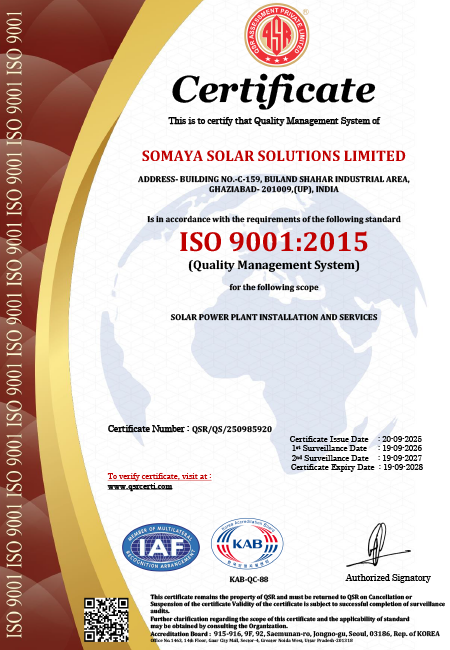
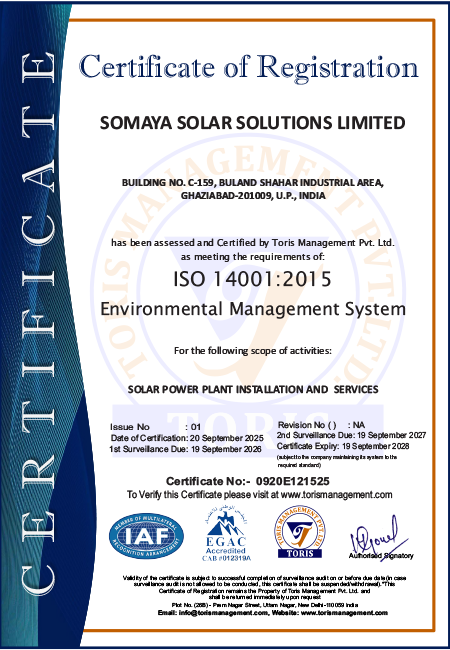
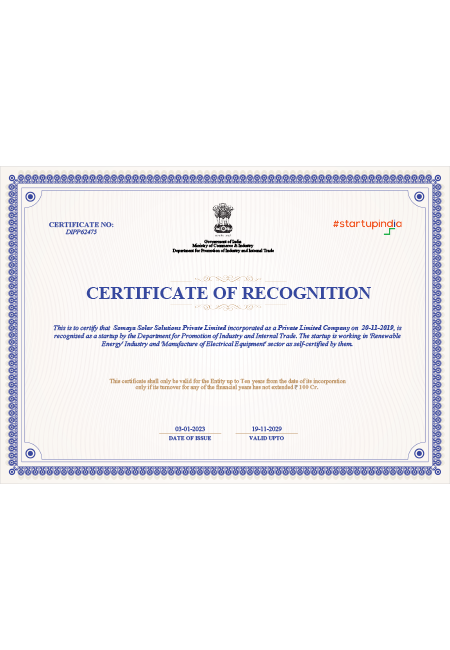
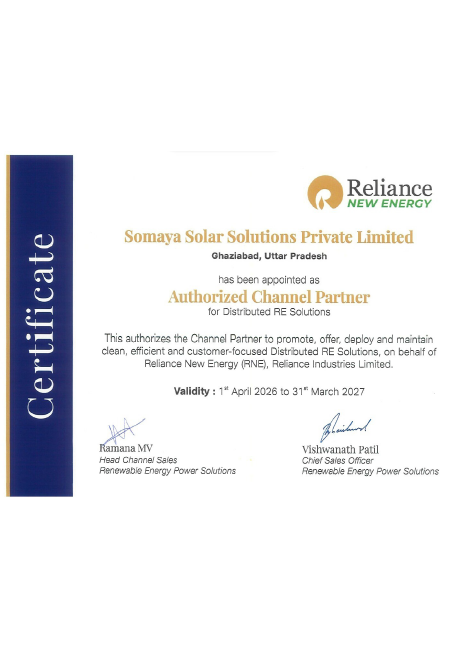
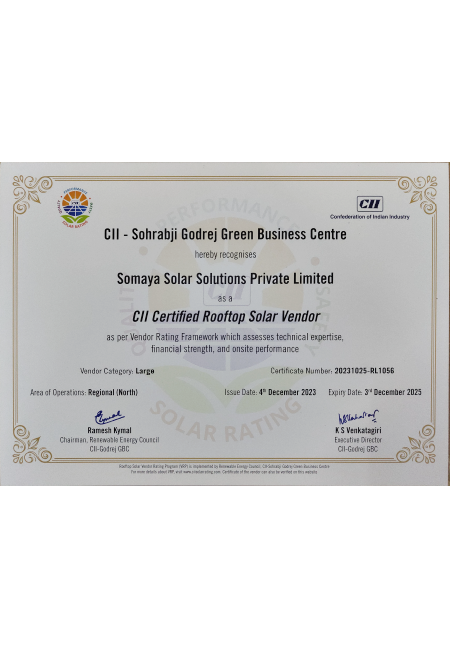
Somaya Solar Solutions Limited builds ground-mounted solar power plants in Jammu and Kashmir for businesses that want their own power and for landowners and developers who sell power to the grid.
Output and land for a ground-mounted plant in Jammu and Kashmir
Solar output changes across Jammu and Kashmir with latitude, haze and temperature. The table shows modelled yearly output for each kW installed, for a low-tilt rooftop array and for a ground-mounted array at the best fixed tilt. Across these places the figure runs from about 1,420 to 1,590 units per kW.
| Place | Rooftop, 10° tilt (kWh per kW a year) | Ground-mounted, best fixed tilt (kWh per kW a year) |
|---|---|---|
| Akhnur | 1,350 | 1,470 |
| Anantnag | 1,430 | 1,550 |
| Badamibagh | 1,440 | 1,550 |
| Bandipura | 1,440 | 1,560 |
| Baramula | 1,420 | 1,540 |
| Bijbehara | 1,440 | 1,560 |
| Doda | 1,420 | 1,540 |
| Dooru Verinag | 1,460 | 1,580 |
| Ganderbal | 1,430 | 1,550 |
| Jammu | 1,360 | 1,470 |
| Jammu Cantonment | 1,360 | 1,470 |
| Kathua | 1,320 | 1,420 |
| Kishtwar | 1,480 | 1,580 |
| Kulgam | 1,460 | 1,590 |
| Pampur | 1,460 | 1,580 |
| Pulwama | 1,430 | 1,560 |
| Punch | 1,360 | 1,480 |
| Rajaori | 1,360 | 1,480 |
| Samba | 1,350 | 1,450 |
| Sopur | 1,390 | 1,520 |
| Srinagar | 1,440 | 1,570 |
| Udhampur | 1,350 | 1,470 |
Output figures are modelled with the European Commission's PVGIS tool (ERA5 weather data, 2005 to 2023) with system losses set at 20%, which is on the cautious side. Real output depends on shading, dust, equipment and layout. A site study gives the figure to plan on.
State policy and open access in Jammu and Kashmir
Under JERC's Green Energy Open Access Regulations, 2024 (notified on 12 February 2024), a consumer with a contract demand or sanctioned load of 100 kW or more, on one connection or on several in the same electricity division, can take green energy through open access. A captive consumer has no load limit.
- Banking is on a monthly basis. The banking charge is 8% of the energy banked, taken in kind. The permitted banked energy is at least 30% of the consumer's monthly consumption from the licensee.
- For 2026-27 the tariff order of 20 August 2026 sets the cross-subsidy surcharge at ₹1.38 per kVAh for all HT consumers. The regulations say the surcharge is not levied when open access carries power from a person's own captive plant to the place of use.
- The Commission did not set an additional surcharge for 2026-27, because JPDCL and KPDCL did not give the fixed-cost details it needed.
- Wheeling charges approved for 2026-27 are ₹0.21 per kWh for HT and ₹0.47 per kWh for LT. Green energy open access uses the same wheeling charges.
What a ground-mounted project involves
A ground-mounted plant needs more groundwork than a rooftop one before any module is fixed.
- Land check: title, slope, soil, drainage, access road and shading
- Distance to the substation or connection point and the line needed to reach it
- Layout, structure design and foundations for the soil
- Supply, installation, testing and commissioning
- Evacuation line, metering and connection approvals
- Fencing, cleaning water and maintenance planning
More detail: Ground-Mounted Solar Plant across India.
Questions about solar projects in Jammu and Kashmir
How much land does a solar plant need?
A fixed-tilt ground-mounted plant typically needs about 4 to 5 acres for each MW. The exact area depends on the module, the tilt and the shape of the plot.
Where is Somaya Solar based?
Somaya Solar Solutions Limited works from C-159, Bulandshahr Road Industrial Area, Ghaziabad, Uttar Pradesh.
What does Somaya Solar need to prepare a proposal?
Twelve months of electricity bills, the sanctioned load or contract demand, the roof or land details with photographs, and the plant size you have in mind if you have one.
Discuss a solar project in Jammu and Kashmir
Send your electricity bills, sanctioned load and roof or land details, and we will reply with a first assessment.
Email: info@somayasolar.com
Phone: +91-8700035846
Sources
Local rules and figures on this page were last checked on 18 November 2026. Rules and tariffs change; confirm the current position before you commit to a project.