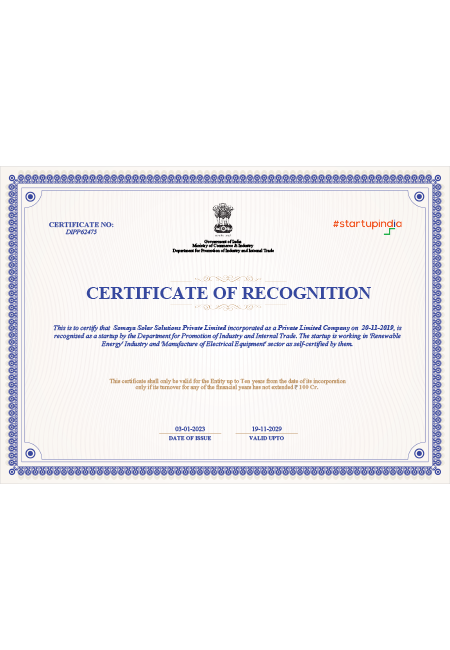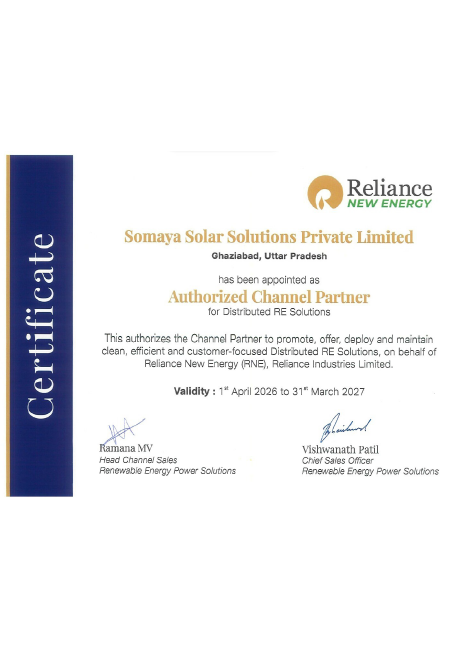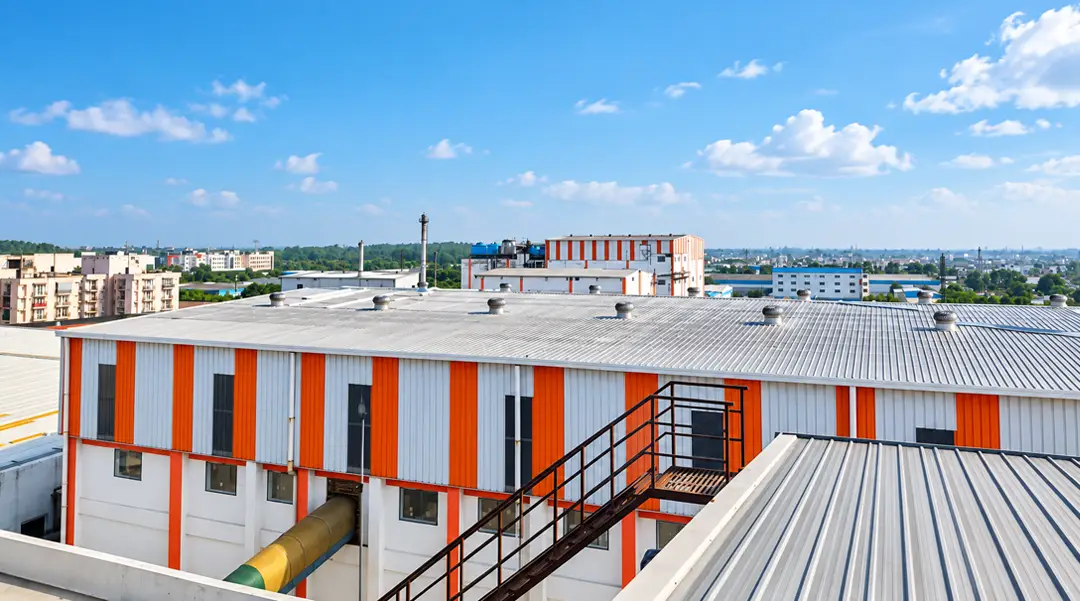
Somaya Solar Solutions Limited installs rooftop solar plants for factories, warehouses, institutions and commercial buildings in Arunachal Pradesh. Most of our published work is megawatt-scale rooftop plants on working industrial sites.
Metering rules for business rooftops in Arunachal Pradesh
In Arunachal Pradesh, grid-connected distributed renewable systems fall under the APERC (Grid Interactive Distributed Renewable Energy System with Net Metering including Group Net Metering and Virtual Net Metering, Net Billing/Net Feed-In, Gross Metering and Its Related Matters) Regulations, 2024, notified on 4 March 2024 and published in the Gazette on 11 March 2024. They replaced the 2016 rooftop regulations.
- Any category of consumer may set up a system of 1 kW to 500 kW under net metering. Group net metering and virtual net metering are for the same range, 1 kW to 500 kW.
- Net billing, which the regulations also call net feed-in, is for 500 kW to 1,000 kW (1 MW). Gross metering is for 1 kW to 1,000 kW (1 MW).
- The system may not be larger than the consumer's sanctioned load or contract demand, and a variation of 5% in rated capacity is allowed. A prosumer picks one arrangement for one premises.
- Under net metering, credits left unused at the end of the financial year are treated as bought by the licensee at its average power purchase cost or the feed-in tariff for that year, whichever is lower. The balance is reset to zero.
- Under net billing, the licensee buys exports at the feed-in tariff approved by the Commission, and imports are billed at the retail tariff.
- The total rooftop capacity on one distribution transformer may not exceed 80% of the transformer's capacity, and the licensee must refuse new connections once it reaches 80%. The cumulative target for the state is 50 MW.
- A feasibility study must be done in 15 days. Applications up to 10 kW are deemed accepted without a study.
Output and bill value for a rooftop plant in Arunachal Pradesh
Solar output changes across Arunachal Pradesh with latitude, haze and temperature. The table shows modelled yearly output for each kW installed, for a low-tilt rooftop array and for a ground-mounted array at the best fixed tilt. Across these places the figure runs from about 940 to 1,120 units per kW.
| Place | Rooftop, 10° tilt (kWh per kW a year) | Ground-mounted, best fixed tilt (kWh per kW a year) |
|---|---|---|
| Along | 1,050 | 1,120 |
| Basar | 1,070 | 1,140 |
| Hawai | 1,110 | 1,170 |
| Itanagar | 1,120 | 1,190 |
| Lemmi | 1,110 | 1,170 |
| Naharlagun | 1,120 | 1,190 |
| Namsai | 1,110 | 1,180 |
| Pangin | 1,010 | 1,070 |
| Pasighat | 1,080 | 1,150 |
| Raga | 990 | 1,050 |
| Tato | 940 | 980 |
Output figures are modelled with the European Commission's PVGIS tool (ERA5 weather data, 2005 to 2023) with system losses set at 20%, which is on the cautious side. Real output depends on shading, dust, equipment and layout. A site study gives the figure to plan on.
How a factory or commercial rooftop project runs
Rooftop plants on working buildings are planned around the roof, the load and the production schedule.
- Roof check: sheet or concrete, load capacity, shading and safe access
- Sizing against daytime load and sanctioned demand, within the metering rules above
- Mounting design to suit the roof, including corrosion protection where the air is harsh
- Installation in stages so production carries on
- Testing, metering and connection with the electricity supplier
- Monitoring and maintenance after handover, where contracted
More detail: Commercial & Industrial Solar across India.
Questions about solar projects in Arunachal Pradesh
Is net metering available for factories and commercial buildings in Arunachal Pradesh?
In Arunachal Pradesh, grid-connected distributed renewable systems fall under the APERC (Grid Interactive Distributed Renewable Energy System with Net Metering including Group Net Metering and Virtual Net Metering, Net Billing/Net Feed-In, Gross Metering and Its Related Matters) Regulations, 2024, notified on 4 March 2024 and published in the Gazette on 11 March 2024. They replaced the 2016 rooftop regulations.
Where is Somaya Solar based?
Somaya Solar Solutions Limited works from C-159, Bulandshahr Road Industrial Area, Ghaziabad, Uttar Pradesh.
What does Somaya Solar need to prepare a proposal?
Twelve months of electricity bills, the sanctioned load or contract demand, the roof or land details with photographs, and the plant size you have in mind if you have one.
Discuss a solar project in Arunachal Pradesh
Send your electricity bills, sanctioned load and roof or land details, and we will reply with a first assessment.
Email: info@somayasolar.com
Phone: +91-8700035846
Sources
Local rules and figures on this page were last checked on 18 November 2026. Rules and tariffs change; confirm the current position before you commit to a project.
- APERC (Grid Interactive Distributed Renewable Energy System with Net Metering, Group and Virtual Net Metering, Net Billing/Net Feed-In, Gross Metering and Its Related Matters) Regulations, 2024 (Arunachal Pradesh Gazette, 11 March 2024)
- PVGIS, European Commission Joint Research Centre (solar output model)