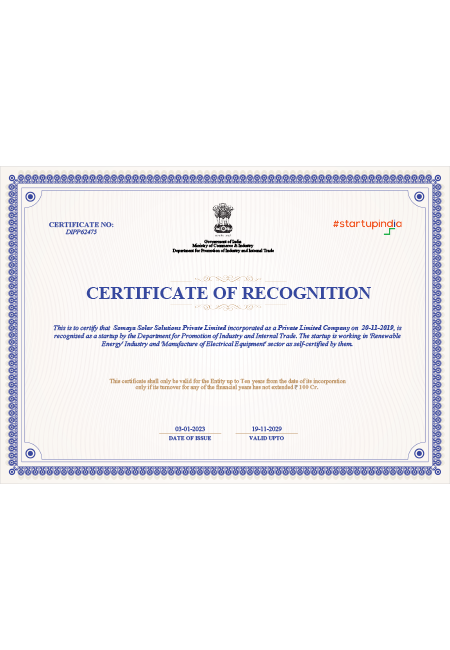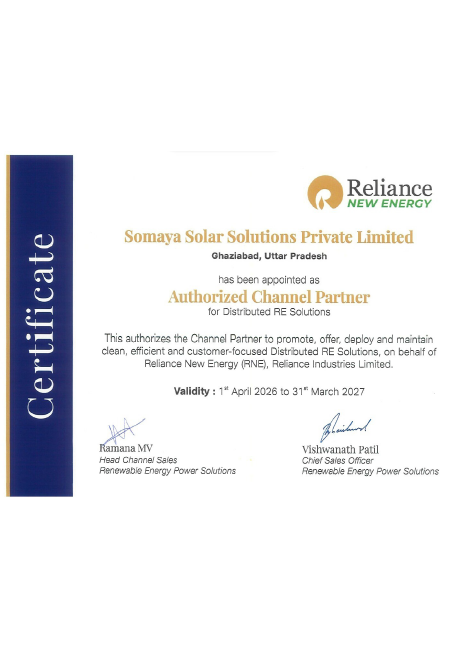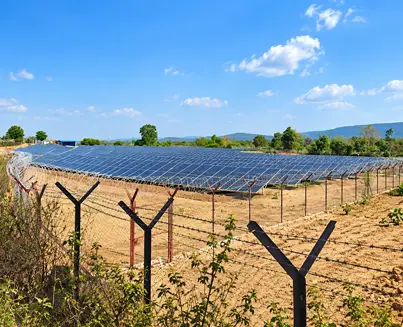
Somaya Solar Solutions Limited builds ground-mounted solar power plants in Odisha for businesses that want their own power and for landowners and developers who sell power to the grid.
Output and land for a ground-mounted plant in Odisha
Solar output changes across Odisha with latitude, haze and temperature. The table shows modelled yearly output for each kW installed, for a low-tilt rooftop array and for a ground-mounted array at the best fixed tilt. Across these places the figure runs from about 1,300 to 1,420 units per kW.
| Place | Rooftop, 10° tilt (kWh per kW a year) | Ground-mounted, best fixed tilt (kWh per kW a year) |
|---|---|---|
| Anandpur | 1,270 | 1,310 |
| Angul | 1,270 | 1,310 |
| Asika | 1,310 | 1,340 |
| Balangir | 1,320 | 1,360 |
| Balasore | 1,370 | 1,410 |
| Bargarh | 1,320 | 1,360 |
| Baripada | 1,310 | 1,360 |
| Barpali | 1,320 | 1,370 |
| Basudebpur | 1,330 | 1,370 |
| Baud | 1,300 | 1,340 |
| Belpahar | 1,320 | 1,370 |
| Bhadrak | 1,330 | 1,370 |
| Bhanjanagar | 1,280 | 1,320 |
| Bhawanipatna | 1,310 | 1,350 |
| Bhuban | 1,280 | 1,310 |
| Bhubaneswar | 1,300 | 1,340 |
| Birmitrapur | 1,320 | 1,370 |
| Brahmapur | 1,360 | 1,390 |
| Brajarajnagar | 1,320 | 1,370 |
| Burla | 1,310 | 1,360 |
| Chhatrapur | 1,390 | 1,420 |
| Choudwar | 1,290 | 1,320 |
| Cuttack | 1,300 | 1,330 |
| Deogarh | 1,320 | 1,360 |
| Dhamanagar | 1,300 | 1,330 |
| Dhenkanal | 1,280 | 1,320 |
| Gunupur | 1,290 | 1,320 |
| Hinjilicut | 1,350 | 1,370 |
| Hirakud | 1,310 | 1,360 |
| Jagatsinghapur | 1,320 | 1,350 |
| Jajpur | 1,300 | 1,330 |
| Jaleshwar | 1,350 | 1,390 |
| Jatani | 1,300 | 1,330 |
| Jeypore | 1,300 | 1,340 |
| Jharsuguda | 1,330 | 1,380 |
| Joda | 1,320 | 1,360 |
| Kantabanji | 1,330 | 1,380 |
| Karanjia | 1,300 | 1,340 |
| Kendraparha | 1,310 | 1,350 |
| Keonjhargarh | 1,300 | 1,340 |
| Khordha | 1,300 | 1,330 |
| Koraput | 1,300 | 1,340 |
| Malakanagiri | 1,270 | 1,300 |
| Paralakhemundi | 1,300 | 1,330 |
| Patamundai | 1,340 | 1,370 |
| Patnagarh | 1,330 | 1,370 |
| Phulbani | 1,310 | 1,350 |
| Polasara | 1,340 | 1,360 |
| Puri | 1,340 | 1,370 |
| Rairangpur | 1,310 | 1,360 |
| Rajgangpur | 1,320 | 1,370 |
| Rayagada | 1,290 | 1,320 |
| Remuna | 1,360 | 1,400 |
| Rourkela | 1,320 | 1,370 |
| Sambalpur | 1,320 | 1,360 |
| Sonepur | 1,320 | 1,360 |
| Soro | 1,330 | 1,370 |
| Sunabeda | 1,310 | 1,340 |
| Sundergarh | 1,330 | 1,380 |
| Talcher | 1,270 | 1,310 |
| Titlagarh | 1,320 | 1,360 |
Output figures are modelled with the European Commission's PVGIS tool (ERA5 weather data, 2005 to 2023) with system losses set at 20%, which is on the cautious side. Real output depends on shading, dust, equipment and layout. A site study gives the figure to plan on.
State policy and open access in Odisha
The Odisha Renewable Energy Policy, 2022 is the state's policy for solar and other renewable projects. The Energy Department issued it as a resolution on 30 November 2022. It stays in force until 31 March 2030 or until the state announces a new policy.
- The policy covers ground-mounted and rooftop solar, floating and canal-top solar, wind, hydro, storage and other renewable projects, for captive use or for sale to a distribution company or a third party.
- The Energy Department designates a Nodal Agency to run the policy. It gives single-window approval, and captive projects get approvals in fast-track mode.
- Captive and open access consumers who use energy from renewable projects set up in the state get 50 paise per unit off electricity duty for 15 years from the project's commissioning.
- Open access consumers of such energy get a 50% exemption on cross-subsidy surcharge for 15 years. Captive and open access consumers get a 25% exemption on wheeling charges for 15 years and 20 paise per unit off STU charges.
- On rooftop solar, the state promotes plants on commercial and industrial buildings under net metering or gross metering, as the regulator's rules provide. Developers may also use the power for captive purposes.
Under OERC's Green Energy Open Access Regulations, 2023, a consumer with a contracted demand or sanctioned load of 100 kW or more, on one connection or on several connections added together, can take green energy through open access. A captive consumer has no load limit.
- Banking is allowed on a monthly cycle only. Banked energy is limited to 30% of the monthly consumption from the distribution company, the banking charge for solar is 8% of the energy banked, and banked energy does not carry over to the next month.
- For 2026-27 the cross-subsidy surcharge for HT consumers is 56.42 paise per unit in the TPCODL area, 1.63 paise in TPNODL, 17.26 paise in TPWODL and 106.02 paise in TPSODL. The cross-subsidy surcharge does not apply if the consumer uses power from his own captive plant.
- The notified 2026-27 wheeling charge is 116.56 paise per unit in the TPCODL area, 180.86 paise in TPNODL, 120.90 paise in TPWODL and 197.32 paise in TPSODL. The transmission charge is ₹240 per MWh.
- The normative wheeling loss at HT level is 7.0% for 2026-27. No additional surcharge is payable over and above the cross-subsidy surcharge.
- Under the state policy, open access consumers of power from renewable projects commissioned in the state pay 50% of the cross-subsidy surcharge. The notification also lists a 25% exemption on wheeling charges and 20 paise per unit off STU charges.
What a ground-mounted project involves
A ground-mounted plant needs more groundwork than a rooftop one before any module is fixed.
- Land check: title, slope, soil, drainage, access road and shading
- Distance to the substation or connection point and the line needed to reach it
- Layout, structure design and foundations for the soil
- Supply, installation, testing and commissioning
- Evacuation line, metering and connection approvals
- Fencing, cleaning water and maintenance planning
More detail: Ground-Mounted Solar Plant across India.
Questions about solar projects in Odisha
How much land does a solar plant need?
A fixed-tilt ground-mounted plant typically needs about 4 to 5 acres for each MW. The exact area depends on the module, the tilt and the shape of the plot.
Where is Somaya Solar based?
Somaya Solar Solutions Limited works from C-159, Bulandshahr Road Industrial Area, Ghaziabad, Uttar Pradesh.
What does Somaya Solar need to prepare a proposal?
Twelve months of electricity bills, the sanctioned load or contract demand, the roof or land details with photographs, and the plant size you have in mind if you have one.
Discuss a solar project in Odisha
Send your electricity bills, sanctioned load and roof or land details, and we will reply with a first assessment.
Email: info@somayasolar.com
Phone: +91-8700035846
Sources
Local rules and figures on this page were last checked on 18 November 2026. Rules and tariffs change; confirm the current position before you commit to a project.
- OERC open access charges notification for 2026-27 (letter of 24 March 2026) and OERC (Promotion of Renewable Energy through Green Energy Open Access) Regulations, 2023, notified 27 December 2023
- Odisha Renewable Energy Policy, 2022 (Energy Department resolution No. 11757 of 30 November 2022, Odisha Gazette Extraordinary No. 3354)
- PVGIS, European Commission Joint Research Centre (solar output model)