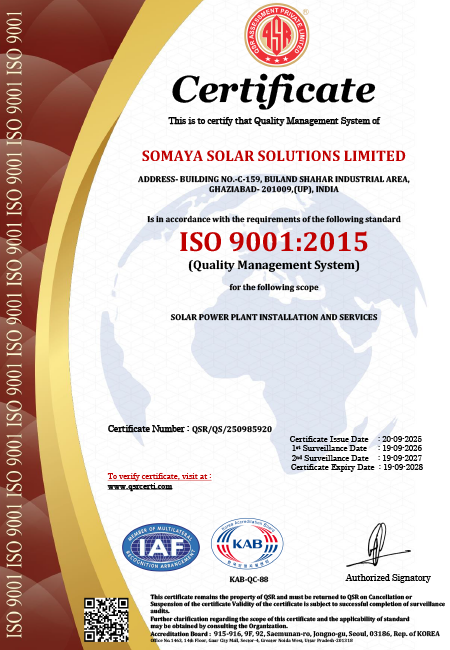
Somaya Solar Solutions Limited is an EPC contractor for PM-KUSUM solar plants. This page sets out how the scheme works for land and pumps in Odisha and what we do on such a project.
What PM-KUSUM covers
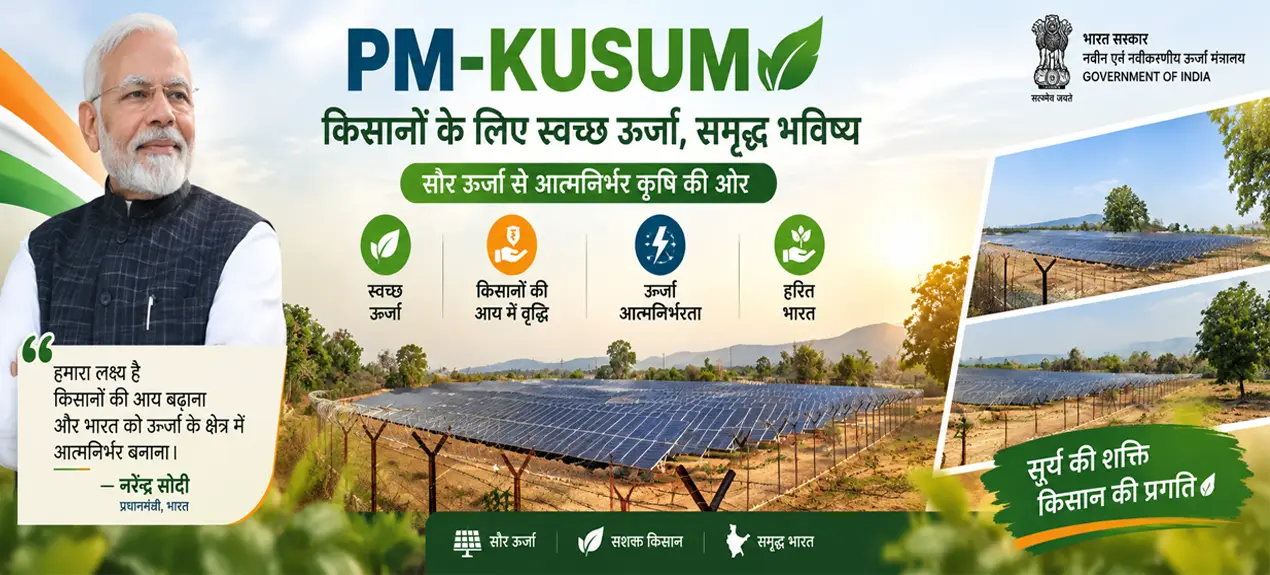
PM-KUSUM is a central government scheme of the Ministry of New and Renewable Energy, run in each state by state implementing agencies. Capacity is allotted to states on demand. The Ministry told the Lok Sabha on 29 July 2026 that the scheme's timeline is extended to 31 March 2027 for all components.
- Component A: decentralised solar plants of up to 2 MW on farmers' land.
- Component B: solar pumps for agriculture.
- Component C: solarisation of grid-connected agriculture pumps, including feeder-level solarisation.
Who runs PM-KUSUM in Odisha
In Odisha the four distribution companies run Component A and Component C: the power purchase agreements for Component A are signed by the distribution company, GRIDCO and the plant owner. OREDA ran the tender for vendors under Component B (standalone solar pumps).
- Progress reported to the Lok Sabha up to 30 June 2026: 2.00 MW under Component A in 2026-27 and nothing in earlier years, and 1,253 solar pumps installed under Component B between 1 April and 30 June 2026, after 8,845 in 2025-26. The Ministry reports nothing for Odisha under Component C.
- In its tariff order of 24 March 2026 the Commission records that the Component A tariff was revised from ₹3.30 to ₹4.40 per kWh. TPCODL reports 8 MW of power purchase agreements signed under Component A as on 30 September 2025.
- TPWODL reports that 30.175 MW has been allotted under Component C feeder solarisation, with land acquisition complete for 14.349 MW.
- The central government has extended the scheme to 31 March 2027 for all components.
What a PM-KUSUM plant produces in Odisha
Solar output changes across Odisha with latitude, haze and temperature. The table shows modelled yearly output for each kW installed, for a low-tilt rooftop array and for a ground-mounted array at the best fixed tilt. Across these places the figure runs from about 1,300 to 1,420 units per kW.
| Place | Rooftop, 10° tilt (kWh per kW a year) | Ground-mounted, best fixed tilt (kWh per kW a year) |
|---|---|---|
| Anandpur | 1,270 | 1,310 |
| Angul | 1,270 | 1,310 |
| Asika | 1,310 | 1,340 |
| Balangir | 1,320 | 1,360 |
| Balasore | 1,370 | 1,410 |
| Bargarh | 1,320 | 1,360 |
| Baripada | 1,310 | 1,360 |
| Barpali | 1,320 | 1,370 |
| Basudebpur | 1,330 | 1,370 |
| Baud | 1,300 | 1,340 |
| Belpahar | 1,320 | 1,370 |
| Bhadrak | 1,330 | 1,370 |
| Bhanjanagar | 1,280 | 1,320 |
| Bhawanipatna | 1,310 | 1,350 |
| Bhuban | 1,280 | 1,310 |
| Bhubaneswar | 1,300 | 1,340 |
| Birmitrapur | 1,320 | 1,370 |
| Brahmapur | 1,360 | 1,390 |
| Brajarajnagar | 1,320 | 1,370 |
| Burla | 1,310 | 1,360 |
| Chhatrapur | 1,390 | 1,420 |
| Choudwar | 1,290 | 1,320 |
| Cuttack | 1,300 | 1,330 |
| Deogarh | 1,320 | 1,360 |
| Dhamanagar | 1,300 | 1,330 |
| Dhenkanal | 1,280 | 1,320 |
| Gunupur | 1,290 | 1,320 |
| Hinjilicut | 1,350 | 1,370 |
| Hirakud | 1,310 | 1,360 |
| Jagatsinghapur | 1,320 | 1,350 |
| Jajpur | 1,300 | 1,330 |
| Jaleshwar | 1,350 | 1,390 |
| Jatani | 1,300 | 1,330 |
| Jeypore | 1,300 | 1,340 |
| Jharsuguda | 1,330 | 1,380 |
| Joda | 1,320 | 1,360 |
| Kantabanji | 1,330 | 1,380 |
| Karanjia | 1,300 | 1,340 |
| Kendraparha | 1,310 | 1,350 |
| Keonjhargarh | 1,300 | 1,340 |
| Khordha | 1,300 | 1,330 |
| Koraput | 1,300 | 1,340 |
| Malakanagiri | 1,270 | 1,300 |
| Paralakhemundi | 1,300 | 1,330 |
| Patamundai | 1,340 | 1,370 |
| Patnagarh | 1,330 | 1,370 |
| Phulbani | 1,310 | 1,350 |
| Polasara | 1,340 | 1,360 |
| Puri | 1,340 | 1,370 |
| Rairangpur | 1,310 | 1,360 |
| Rajgangpur | 1,320 | 1,370 |
| Rayagada | 1,290 | 1,320 |
| Remuna | 1,360 | 1,400 |
| Rourkela | 1,320 | 1,370 |
| Sambalpur | 1,320 | 1,360 |
| Sonepur | 1,320 | 1,360 |
| Soro | 1,330 | 1,370 |
| Sunabeda | 1,310 | 1,340 |
| Sundergarh | 1,330 | 1,380 |
| Talcher | 1,270 | 1,310 |
| Titlagarh | 1,320 | 1,360 |
Output figures are modelled with the European Commission's PVGIS tool (ERA5 weather data, 2005 to 2023) with system losses set at 20%, which is on the cautious side. Real output depends on shading, dust, equipment and layout. A site study gives the figure to plan on.
What Somaya Solar does on a PM-KUSUM plant
Somaya Solar works as the EPC contractor for the farmer, developer or group that holds the allocation. It does not allot capacity or decide subsidy.
- Site check of the land and its distance from the substation
- Plant design and equipment supply
- Installation, testing and commissioning
- The line to the substation and coordination with the electricity supplier
- Support with the documents the implementing agency asks for
More detail: PM-KUSUM across India.
Questions about solar projects in Odisha
Who do I apply to for PM-KUSUM in Odisha?
In Odisha the four distribution companies run Component A and Component C: the power purchase agreements for Component A are signed by the distribution company, GRIDCO and the plant owner. OREDA ran the tender for vendors under Component B (standalone solar pumps).
How much land does a solar plant need?
A fixed-tilt ground-mounted plant typically needs about 4 to 5 acres for each MW. The exact area depends on the module, the tilt and the shape of the plot.
Where is Somaya Solar based?
Somaya Solar Solutions Limited works from C-159, Bulandshahr Road Industrial Area, Ghaziabad, Uttar Pradesh.
What does Somaya Solar need to prepare a proposal?
Twelve months of electricity bills, the sanctioned load or contract demand, the roof or land details with photographs, and the plant size you have in mind if you have one.
Discuss a solar project in Odisha
Send your electricity bills, sanctioned load and roof or land details, and we will reply with a first assessment.
Email: info@somayasolar.com
Phone: +91-8700035846
Sources
Local rules and figures on this page were last checked on 18 November 2026. Rules and tariffs change; confirm the current position before you commit to a project.
- Lok Sabha Unstarred Question 1613, answered 29 July 2026 (Ministry of New and Renewable Energy)
- Lok Sabha Unstarred Question 1613, answered 29 July 2026 (Ministry of New and Renewable Energy); OERC common tariff order of 24 March 2026; OREDA tender call for PM-KUSUM B
- PVGIS, European Commission Joint Research Centre (solar output model)