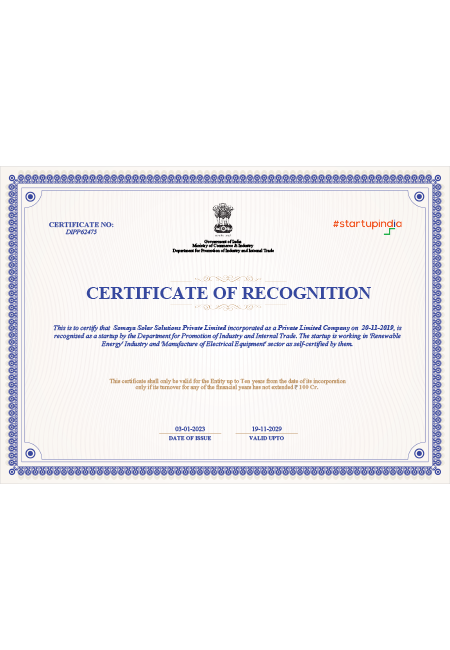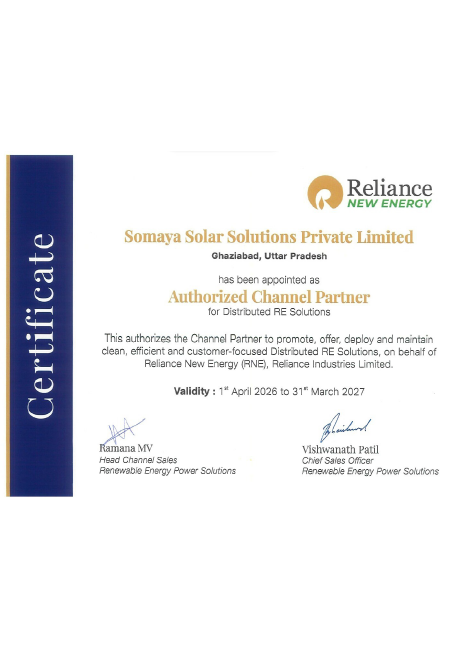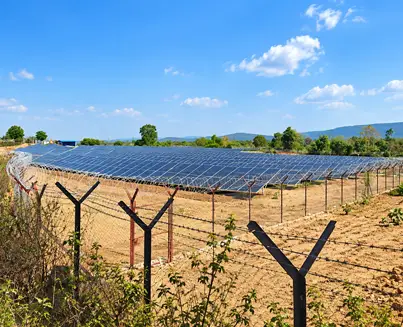
Somaya Solar Solutions Limited builds ground-mounted solar power plants in Haryana for businesses that want their own power and for landowners and developers who sell power to the grid.
Output and land for a ground-mounted plant in Haryana
Solar output changes across Haryana with latitude, haze and temperature. The table shows modelled yearly output for each kW installed, for a low-tilt rooftop array and for a ground-mounted array at the best fixed tilt. Across these places the figure runs from about 1,490 to 1,560 units per kW.
| Place | Rooftop, 10° tilt (kWh per kW a year) | Ground-mounted, best fixed tilt (kWh per kW a year) |
|---|---|---|
| Ambala | 1,400 | 1,500 |
| Ambala Sadar | 1,400 | 1,500 |
| Asandh | 1,420 | 1,510 |
| Bahadurgarh | 1,420 | 1,520 |
| Barara | 1,400 | 1,500 |
| Bawal | 1,430 | 1,520 |
| Bawani Khera | 1,430 | 1,530 |
| Bhiwani | 1,430 | 1,520 |
| Charkhi Dadri | 1,430 | 1,520 |
| Chika | 1,410 | 1,510 |
| Dabwali | 1,450 | 1,540 |
| Dharuhera | 1,430 | 1,520 |
| Ellenabad | 1,460 | 1,560 |
| Faridabad | 1,420 | 1,510 |
| Fatehabad | 1,440 | 1,530 |
| Firozpur Jhirka | 1,420 | 1,510 |
| Ganaur | 1,420 | 1,510 |
| Gharaunda | 1,410 | 1,510 |
| Gohana | 1,430 | 1,520 |
| Gurugram | 1,420 | 1,510 |
| Hisar | 1,450 | 1,540 |
| Hodal | 1,420 | 1,500 |
| Jagadhri | 1,380 | 1,490 |
| Jhajjar | 1,430 | 1,520 |
| Jind | 1,420 | 1,520 |
| Kaithal | 1,420 | 1,510 |
| Kalanaur | 1,430 | 1,520 |
| Kalanwali | 1,440 | 1,540 |
| Karnal | 1,420 | 1,510 |
| Kharkhauda | 1,420 | 1,520 |
| Kundli | 1,420 | 1,510 |
| Kurukshetra | 1,410 | 1,510 |
| Ladwa | 1,400 | 1,500 |
| Maham | 1,430 | 1,520 |
| Mahendragarh | 1,440 | 1,530 |
| Mandi Dabwali | 1,450 | 1,540 |
| Manesar | 1,430 | 1,520 |
| Naraingarh | 1,390 | 1,490 |
| Narnaul | 1,440 | 1,530 |
| Narwana | 1,430 | 1,520 |
| Palwal | 1,420 | 1,510 |
| Panchkula | 1,390 | 1,500 |
| Panipat | 1,420 | 1,510 |
| Pataudi | 1,430 | 1,520 |
| Pehowa | 1,420 | 1,520 |
| Pinjaur | 1,380 | 1,490 |
| Punahana | 1,420 | 1,500 |
| Pundri | 1,420 | 1,510 |
| Rania | 1,440 | 1,540 |
| Ratia | 1,440 | 1,530 |
| Rewari | 1,430 | 1,520 |
| Rohtak | 1,430 | 1,520 |
| Safidon | 1,420 | 1,520 |
| Samalkha | 1,420 | 1,510 |
| Sampla | 1,420 | 1,510 |
| Shahabad | 1,410 | 1,510 |
| Sirsa | 1,440 | 1,540 |
| Sohna | 1,420 | 1,510 |
| Sonipat | 1,420 | 1,510 |
| Taoru | 1,430 | 1,520 |
| Thanesar | 1,410 | 1,510 |
| Tirawari | 1,410 | 1,510 |
| Tohana | 1,430 | 1,530 |
| Yamunanagar | 1,390 | 1,490 |
Output figures are modelled with the European Commission's PVGIS tool (ERA5 weather data, 2005 to 2023) with system losses set at 20%, which is on the cautious side. Real output depends on shading, dust, equipment and layout. A site study gives the figure to plan on.
State policy and open access in Haryana
The Haryana Solar Power Policy, 2016 is the state's notified solar policy. It came into force on 14 March 2016 and stays in force until a new policy is notified. The state published a draft Haryana Solar Power Policy, 2023 for public comments, but the state agency's policy page still lists it as a draft.
- Target: the policy planned 3,200 MW of solar power in Haryana by 2021-22 and 1,600 MW of rooftop solar by 2021-22. No later notified target was found.
- The Renewable Energy Department is the nodal agency for the policy. With HAREDA it also acts as the single window for clearances.
- Rooftop plants of 1 kWp to 1 MWp on industries, institutions and commercial buildings are promoted for captive use or net metering, under the regulator's regulations. No permission is needed from the building plan sanctioning authority.
- A developer may set up a ground-mounted plant at its own cost for captive use, on the same premises or elsewhere in the state, or for sale to a third party, without approval from the Haryana Power Purchase Centre (addendum of 23 June 2017).
Under Haryana's Green Energy Open Access Regulations, 2023, as amended on 25 February 2025, a consumer with a contract demand or sanctioned load of 100 kW or more can take renewable power through open access. The 100 kW can be one connection or several connections in the same operation division of a distribution company.
- There is no limit on the supply of power for captive consumers under green energy open access.
- Banking is open to captive renewable plants in which one captive user holds at least 26% of the ownership. The charge is 8% of the banked energy, taken in units. Banked energy must be used in the same billing cycle, may not exceed 30% of the consumer's monthly consumption from the distribution company, and cannot be drawn in peak hours.
- For 2026-27 the cross-subsidy surcharge is ₹1.45 per unit for HT supply and ₹1.18 per unit for LT supply. The additional surcharge is ₹1.37 per unit from 30 April 2026. Under the regulations, the additional surcharge does not apply to a green energy open access consumer who pays fixed charges.
- For 2026-27 the wheeling charge is ₹0.73 per unit at HT and ₹0.94 per unit at LT. The transmission charge for short-term open access is ₹0.34 per unit.
- Standby power from the distribution company is charged at 125% of the energy charge for the consumer's tariff category, unless the consumer gives a day's notice.
- To accept captive status, UHBVN asks for a HAREDA registration or NOC and an undertaking to meet the 51% consumption requirement (instruction of 9 February 2026).
- The State Load Despatch Centre grants short-term open access (up to one month). The State Transmission Utility grants medium-term and long-term open access.
What a ground-mounted project involves
A ground-mounted plant needs more groundwork than a rooftop one before any module is fixed.
- Land check: title, slope, soil, drainage, access road and shading
- Distance to the substation or connection point and the line needed to reach it
- Layout, structure design and foundations for the soil
- Supply, installation, testing and commissioning
- Evacuation line, metering and connection approvals
- Fencing, cleaning water and maintenance planning
More detail: Ground-Mounted Solar Plant across India.
Questions about solar projects in Haryana
How much land does a solar plant need?
A fixed-tilt ground-mounted plant typically needs about 4 to 5 acres for each MW. The exact area depends on the module, the tilt and the shape of the plot.
Where is Somaya Solar based?
Somaya Solar Solutions Limited works from C-159, Bulandshahr Road Industrial Area, Ghaziabad, Uttar Pradesh.
What does Somaya Solar need to prepare a proposal?
Twelve months of electricity bills, the sanctioned load or contract demand, the roof or land details with photographs, and the plant size you have in mind if you have one.
Discuss a solar project in Haryana
Send your electricity bills, sanctioned load and roof or land details, and we will reply with a first assessment.
Email: info@somayasolar.com
Phone: +91-8700035846
Sources
Local rules and figures on this page were last checked on 17 November 2026. Rules and tariffs change; confirm the current position before you commit to a project.
- HERC (Green Energy Open Access) Regulations, 2023, notified 24 April 2023, with the first amendment of 25 February 2025 (UHBVN Sales Circulars U-07/2023 and U-02/2025), and the 2026-27 tariff schedule (UHBVN Sales Circulars U-03/2026 of 21 April 2026 and U-06/2026 of 13 May 2026)
- Haryana Solar Power Policy, 2016 (Renewable Energy Department, Government of Haryana, notification of 14 March 2016), with addenda of 19 May 2016 and 23 June 2017
- PVGIS, European Commission Joint Research Centre (solar output model)