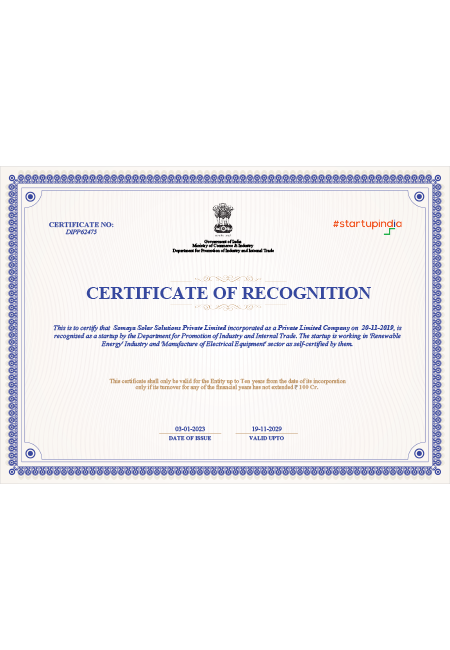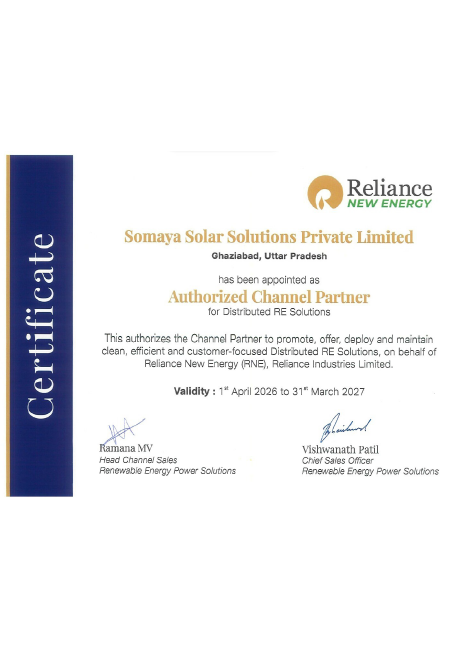
Somaya Solar Solutions Limited is a solar EPC company that takes up rooftop and ground-mounted projects in Haryana. EPC means one contractor does the engineering, buys the equipment, builds the plant and hands it over working.
Haryana at a glance for solar projects
| Electricity regulator | Haryana Electricity Regulatory Commission (HERC) |
|---|---|
| State renewable energy agency | Haryana Renewable Energy Development Agency, under the Department of New & Renewable Energy, Haryana (HAREDA) |
| Electricity distribution | UHBVN (Panchkula, Ambala, Yamunanagar, Kurukshetra, Kaithal, Karnal, Panipat, Sonipat, Rohtak and Jhajjar districts (north Haryana)); DHBVN (Faridabad, Palwal, Nuh, Gurugram, Mahendragarh, Rewari, Bhiwani, Charkhi Dadri, Hisar, Fatehabad, Sirsa and Jind districts (south Haryana)) |
| State solar policy | Haryana Solar Power Policy, 2016 (notified 14 March 2016; in force until a new policy is notified) |
| Rooftop metering for businesses | Net metering up to 500 kW, within the sanctioned load |
What our EPC scope covers
An EPC contract puts engineering, procurement and construction with one company, so one party answers for design, equipment and the working plant.
- Site survey and a study of your electricity use and bills
- Plant design, drawings and equipment selection
- Supply of modules, inverters, mounting structures and electrical equipment
- Installation, testing and commissioning
- Paperwork and coordination with the electricity supplier for connection and metering, where it is in the contract
- Operation and maintenance after handover, where contracted
More detail: Solar EPC Company across India.
Connecting a plant to the grid in Haryana
In Haryana, net metering is open to every consumer except agricultural tube-well consumers, for loads up to 500 kW or up to the sanctioned load or contract demand, whichever is lower. The rules are in the regulator's rooftop solar regulations of 2021, last amended on 30 October 2025.
- Gross metering is the other arrangement under the same regulations. It is allowed up to the sanctioned load or contract demand. Net billing, group net metering and virtual net metering do not appear in the regulations or their two amendments.
- The plant may not be larger than the sanctioned load (low-tension connection) or the contract demand (high-tension connection). The smallest plant allowed is 1 kW.
- The total rooftop capacity on one distribution transformer may not exceed 50% of that transformer's rated capacity. On a power transformer the limit is 30%.
- The second amendment, notified on 30 October 2025 and published in the gazette on 11 November 2025, removed the old rule that set off solar units against only 90% of consumption. The settlement period now runs from 1 October to 30 September.
- Units left unadjusted at the end of the settlement period are bought by the distribution company at 90% of the feed-in tariff in the regulations. The 2021 regulations set that tariff at ₹3.11 per unit for five years. Check the current rate with the distribution company.
- A consumer who draws power through open access cannot have net metering. A plant larger than the sanctioned load or contract demand has to use a route other than net or gross metering.
- The plant may be owned by the consumer or by a third party (RESCO model). The consumer keeps paying fixed or demand charges.
What a plant produces in Haryana
Solar output changes across Haryana with latitude, haze and temperature. The table shows modelled yearly output for each kW installed, for a low-tilt rooftop array and for a ground-mounted array at the best fixed tilt. Across these places the figure runs from about 1,380 to 1,460 units per kW.
| Place | Rooftop, 10° tilt (kWh per kW a year) | Ground-mounted, best fixed tilt (kWh per kW a year) |
|---|---|---|
| Ambala | 1,400 | 1,500 |
| Ambala Sadar | 1,400 | 1,500 |
| Asandh | 1,420 | 1,510 |
| Bahadurgarh | 1,420 | 1,520 |
| Barara | 1,400 | 1,500 |
| Bawal | 1,430 | 1,520 |
| Bawani Khera | 1,430 | 1,530 |
| Bhiwani | 1,430 | 1,520 |
| Charkhi Dadri | 1,430 | 1,520 |
| Chika | 1,410 | 1,510 |
| Dabwali | 1,450 | 1,540 |
| Dharuhera | 1,430 | 1,520 |
| Ellenabad | 1,460 | 1,560 |
| Faridabad | 1,420 | 1,510 |
| Fatehabad | 1,440 | 1,530 |
| Firozpur Jhirka | 1,420 | 1,510 |
| Ganaur | 1,420 | 1,510 |
| Gharaunda | 1,410 | 1,510 |
| Gohana | 1,430 | 1,520 |
| Gurugram | 1,420 | 1,510 |
| Hisar | 1,450 | 1,540 |
| Hodal | 1,420 | 1,500 |
| Jagadhri | 1,380 | 1,490 |
| Jhajjar | 1,430 | 1,520 |
| Jind | 1,420 | 1,520 |
| Kaithal | 1,420 | 1,510 |
| Kalanaur | 1,430 | 1,520 |
| Kalanwali | 1,440 | 1,540 |
| Karnal | 1,420 | 1,510 |
| Kharkhauda | 1,420 | 1,520 |
| Kundli | 1,420 | 1,510 |
| Kurukshetra | 1,410 | 1,510 |
| Ladwa | 1,400 | 1,500 |
| Maham | 1,430 | 1,520 |
| Mahendragarh | 1,440 | 1,530 |
| Mandi Dabwali | 1,450 | 1,540 |
| Manesar | 1,430 | 1,520 |
| Naraingarh | 1,390 | 1,490 |
| Narnaul | 1,440 | 1,530 |
| Narwana | 1,430 | 1,520 |
| Palwal | 1,420 | 1,510 |
| Panchkula | 1,390 | 1,500 |
| Panipat | 1,420 | 1,510 |
| Pataudi | 1,430 | 1,520 |
| Pehowa | 1,420 | 1,520 |
| Pinjaur | 1,380 | 1,490 |
| Punahana | 1,420 | 1,500 |
| Pundri | 1,420 | 1,510 |
| Rania | 1,440 | 1,540 |
| Ratia | 1,440 | 1,530 |
| Rewari | 1,430 | 1,520 |
| Rohtak | 1,430 | 1,520 |
| Safidon | 1,420 | 1,520 |
| Samalkha | 1,420 | 1,510 |
| Sampla | 1,420 | 1,510 |
| Shahabad | 1,410 | 1,510 |
| Sirsa | 1,440 | 1,540 |
| Sohna | 1,420 | 1,510 |
| Sonipat | 1,420 | 1,510 |
| Taoru | 1,430 | 1,520 |
| Thanesar | 1,410 | 1,510 |
| Tirawari | 1,410 | 1,510 |
| Tohana | 1,430 | 1,530 |
| Yamunanagar | 1,390 | 1,490 |
Output figures are modelled with the European Commission's PVGIS tool (ERA5 weather data, 2005 to 2023) with system losses set at 20%, which is on the cautious side. Real output depends on shading, dust, equipment and layout. A site study gives the figure to plan on.
Questions about solar projects in Haryana
Is net metering available for factories and commercial buildings in Haryana?
In Haryana, net metering is open to every consumer except agricultural tube-well consumers, for loads up to 500 kW or up to the sanctioned load or contract demand, whichever is lower. The rules are in the regulator's rooftop solar regulations of 2021, last amended on 30 October 2025.
Where is Somaya Solar based?
Somaya Solar Solutions Limited works from C-159, Bulandshahr Road Industrial Area, Ghaziabad, Uttar Pradesh.
What does Somaya Solar need to prepare a proposal?
Twelve months of electricity bills, the sanctioned load or contract demand, the roof or land details with photographs, and the plant size you have in mind if you have one.
Discuss a solar project in Haryana
Send your electricity bills, sanctioned load and roof or land details, and we will reply with a first assessment.
Email: info@somayasolar.com
Phone: +91-8700035846
Sources
Local rules and figures on this page were last checked on 17 November 2026. Rules and tariffs change; confirm the current position before you commit to a project.
- Department of New & Renewable Energy, Haryana (HAREDA) website, and Haryana Solar Power Policy, 2016 (notified 14 March 2016)
- HERC (Rooftop Solar Grid Interactive Systems Based on Net Metering/Gross Metering) Regulations, 2021, notified 19 July 2021, with the first amendment of 15 July 2024 and the second amendment of 30 October 2025 (as circulated in UHBVN Sales Circulars U-29/2021, U-33/2024 and U-16/2025)
- Haryana Government Gazette of 11 November 2025 (HERC notification of 30 October 2025), as circulated in UHBVN Sales Circular U-16/2025
- Haryana Solar Power Policy, 2016 (Renewable Energy Department, Government of Haryana, notification of 14 March 2016), with addenda of 19 May 2016 and 23 June 2017
- PVGIS, European Commission Joint Research Centre (solar output model)
- UHBVN 'About us' page and DHBVN 'About DHBVN' page (https://www.dhbvn.org.in/web/portal/about-dhbvn)